
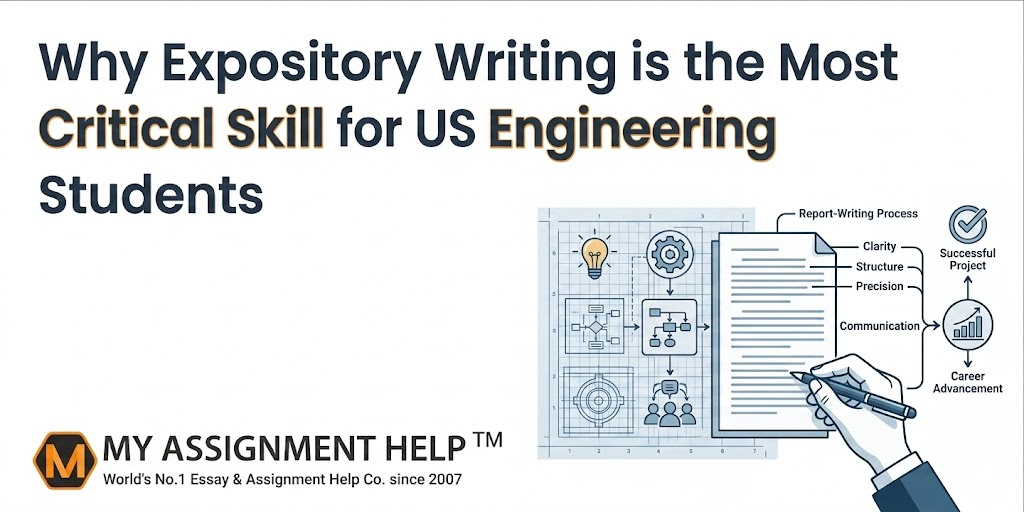
In the landscape of 21st-century American industry, the image of the “lone engineer” hunched over a drafting table is obsolete. Today’s engineering feats—from the SpaceX Starship to the revitalization of the US power grid—are products of massive collaborative networks. Within these networks, technical brilliance is a baseline requirement, but the ability to communicate that brilliance is the true differentiator. For the American engineering student, expository writing is not merely an elective hurdle; it is the fundamental bridge between a conceptual design and a functional reality.
Expository writing serves as the objective voice of science. Unlike persuasive essays that lean on rhetoric, an expository piece relies on facts, data, and logical sequences to explain complex phenomena. Given the rigorous demands of the US curriculum, many future professionals often utilize an expository essay writing service to ensure their technical documentation meets the precision required by the Accreditation Board for Engineering and Technology (ABET). This disciplined approach to writing ensures that every technical specification and safety protocol is understood by stakeholders who may not share the engineer’s specialized background.
Transitioning from the classroom to a professional firm involves a steep learning curve in documentation standards. Many students find that learning to buy essays online for college which are authored by subject matter experts provides them with a structural template for industry-grade reports. In the US market, where litigation and safety standards are paramount, the clarity provided by expository mastery is the engineer’s greatest tool for risk mitigation and project approval.
1. The Translation of Innovation into Implementation
Innovation in the United States is driven by the ability to secure funding and regulatory approval. Whether an engineer is working for a Silicon Valley startup or a federal agency like NASA, they must “sell” their ideas through clarity. Expository writing allows an engineer to deconstruct a multi-million dollar mechanical system into a feasibility report that a venture capitalist or a politician can understand. Without this skill, the most advanced technological breakthroughs remain trapped in the laboratory.
2. Adherence to ABET Student Outcomes
The Accreditation Board for Engineering and Technology (ABET) is the gold standard for US engineering education. ABET “Student Outcome 3” explicitly mandates that students demonstrate “an ability to communicate effectively with a range of audiences.” This is not an accidental inclusion. The industry recognizes that an engineer who cannot document their work effectively is a liability to the team’s collective E-E-A-T (Experience, Expertise, Authoritativeness, and Trustworthiness).
3. Safety and Legal Documentation
In the United States, the “Engineer’s Log” and “Project Specifications” are legal documents. In the event of a structural failure or a product recall, these writings are scrutinized in courts of law. Expository writing—characterized by its focus on objective truth and sequence—ensures that safety instructions are unambiguous. A single poorly explained variable in a manual can lead to catastrophic hardware failure, making the clear explanation of “how” and “why” a life-saving skill.
Key Takeaways for Future Engineers
- Bridge the Gap: Use expository writing to explain technical data to non-technical decision-makers.
- Career Acceleration: High-level writing skills are the fastest path to management and leadership roles.
- Legal Protection: Clear, factual documentation reduces professional liability and ensures safety compliance.
- Academic Integrity: Mastering expository structures early prevents common pitfalls in senior capstone projects.
See also: Blockchain in Healthcare
4. Establishing Authoritative Expertise (E-E-A-T)
Professional stature in engineering is built on more than just patents; it is built on published contributions. When engineers write white papers or contribute to industry journals, they are evaluated on the clarity of their expository prose. This builds “Authoritativeness”—a key pillar of the E-E-A-T framework. A well-written technical blog or conference paper signals to the industry that the author possesses not just the technical “know-how,” but the intellectual discipline to share that knowledge reliably.
Frequently Asked Questions (FAQ)
Q: Is expository writing the same as a technical report?
A: Effectively, yes. While “expository essay” is the academic term, its principles—clarity, organization, and evidence—form the foundation of every professional technical report used in US engineering firms.
Q: Why do US universities emphasize writing for STEM majors?
A: US industries place a high value on “soft skills.” Because engineering is increasingly multidisciplinary, the ability to explain a civil engineering concept to an electrical engineer or a city planner is essential for project completion.
Q: Can writing skills affect my starting salary?
A: Absolutely. NACE surveys indicate that communication skills are among the top three attributes employers look for, often determining which candidates are fast-tracked for project lead positions.
Author Bio
Dr. Jonathan Pierce is a Lead Content Strategist and Academic Consultant at MyAssignmentHelp. With a background in Applied Physics and a PhD in Technical Communication from the University of Texas, Dr. Pierce has dedicated over a decade to helping engineering students navigate the complexities of professional documentation. He is a frequent contributor to journals on STEM pedagogy and is an expert in the application of E-E-A-T standards to academic and technical content.
References & Data Sources:
- National Association of Colleges and Employers (NACE), Job Outlook 2024.
- ABET, Criteria for Accrediting Engineering Programs, 2024-2025.
- American Society for Engineering Education (ASEE), “Integrating Communication into the Engineering Curriculum.”
- U.S. Bureau of Labor Statistics, Occupational Outlook for Engineers.
